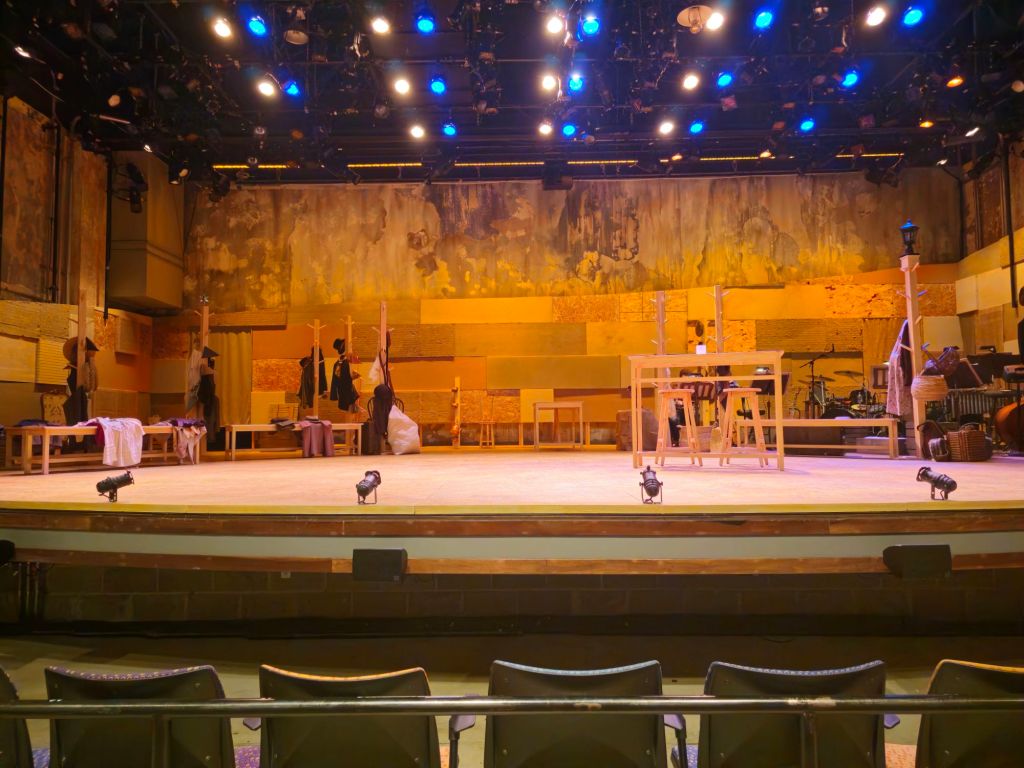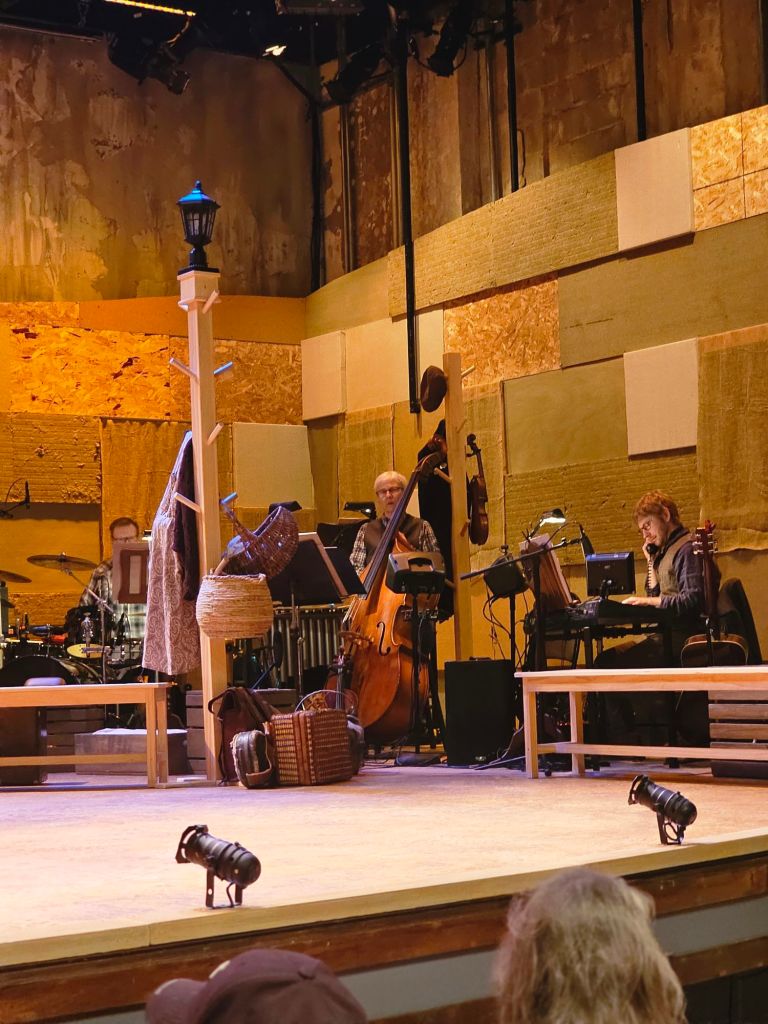
• The Guthrie’s new production of William Shakespeare’s Macbeth is a tense thriller that showcases new dimensions to one of the Bard’s darkest tragedies. Cutting down Shakespeare’s text to less than two hours and running the show without an intermission enhances the overall sense of claustrophobia, but one also gets the sense that the cast might have done evem better had they had more of Shakespeare’s dialogue to work with.

    Director Joe Dowling creates some incredibly striking stage images through his use of blocking and lighting. The opening sequence with the Weird Sisters, with its combination of music, fog, strobe-like lighting, and stylized choreography gets the show off to an appropriately moody start, and one early soliloquy by Macbeth has him speaking to his own shadow, looming over him as he tries to figure out whether to pursue his dark ambition. Most of the effects in this production are done through lighting and choreography, as unlike some previous Guthrie Shakespeare productions, this is done with a minimum of props and scenery. The locations are invoked by smoke, sound effects, and the occasional use of projections, while the cast is costumed mostly in black military garb. All of this serves Dowling’s vision that turns Macbeth into the center of a paranoid thriller as much as a tragedy.

    Daniel José Molina plays Macbeth, returning to the Guthrie several years after his remarkable work playing Prince Hal/Henry V in their production of Shakespeare’s Henriad. He brings a similar sense of youthful energy to Macbeth, but as the show progresses you also get the sense that despite the jovial attitude on display in the early scenes with his fellow soldiers, there was always a dark streak in him, and all that it took to push him into murder and tyranny was a little push.

    In most productions of Macbeth the title character is portrayed as wracked by guilt both before and after murdering Duncan, only going through with it due to the encouragement and manipulation from his wife. Here, Macbeth seems tormented less by guilt than driven by a sense of self-preservation. Yes, he requires a push from Lady Macbeth (Meghan Kriedler, in an excellent performance), but once he’s killed Duncan and secured the crown for himself, he thinks little of ordering Banquo’s murder to preserve his own position or the murder of Macduff’s whole family simply to send a message. Indeed, he becomes so remorseless that Lady Macbeth herself is disturbed by what she sees. Meghan Kriedler’s Lady Macbeth is different from any other portrayal of the character I’ve seen – it’s easy to play the part like a devious villain, pushing Macbeth into regicide against his better judgment. But Kriedler finds something more complicated than that – you almost get the sense that she’s pushing him out of a twisted sense of love, encouraging to get him to follow through on ambitions she always knew he had. Later, as her husband descends into tyrannical madness, she seems truly frightened by him, and the guilt that drives her to suicide comes not just from her role in Duncan’s murder, but in realizing she played a role in the rise of a monster. This Macbeth isn’t the story of a tragic hero and his villainous wife – it’s a portrayal of a toxic marriage between two people matched in ambition and ruthlessness and the realization that the husband was a villain all along.

    Molina and Kriedler are surrounded by a supporting cast full of local veteran actors – Bill McCallum makes for a warm and charismatic Duncan, Peter Christian Hansen plays Banquo, loyal to Macbeth until he realizes too late that their friendship is entirely one-sided, while Regina Marie Williams showcases her remarkable stage presence as the lead Weird Sister. Almost everybody in the supporting cast doubles or triples up on roles, and it’s a testament to their talent as performers and Joe Dowling’s direction that there is never a sense of confusion as to who is playing who.

    One more thing that contrasts this production from previous Shakespeare plays I’ve seen at the Guthrie is the comparative lack of humor. Granted, Macbeth isn’t exactly one of the Bard’s funnier plays, but even in the productions of Hamlet and the history plays the Guthrie has put on in recent years the actors brought a lot of comedy out of the drama, sometimes in unexpected ways. You don’t get a lot of that here. There are occasional laughs, but the humor that exists is mostly deadpan, small bits of relief before the tension ratchets up again. This might be another result of the text being cut down for time purposes. What is clear, however, is that this vision of Macbeth is truly distinctive, a focused and striking production all the way through. It’s filled with unforgettable moments, from the opening invocation by the Weird Sisters, to a final stage image that will stick in my mind for a long time.

    MACBETH runs at the Wurtele Thrust Stage at the Guthrie through March 22nd

  • For most young people, “living in the moment” means taking advantage of your youth – doing the things you won’t be able to once you’re grown up. But for Kimberly Velaco it’s different. She has a medical condition that causes her to age at four times the natural rate, so at 15 she looks like she’s in her late sixties. Kimberly is a person who has to learn that you’re only young once when she’s never really had the chance to be young at all.   And yet, somehow, that’s the least of her problems.

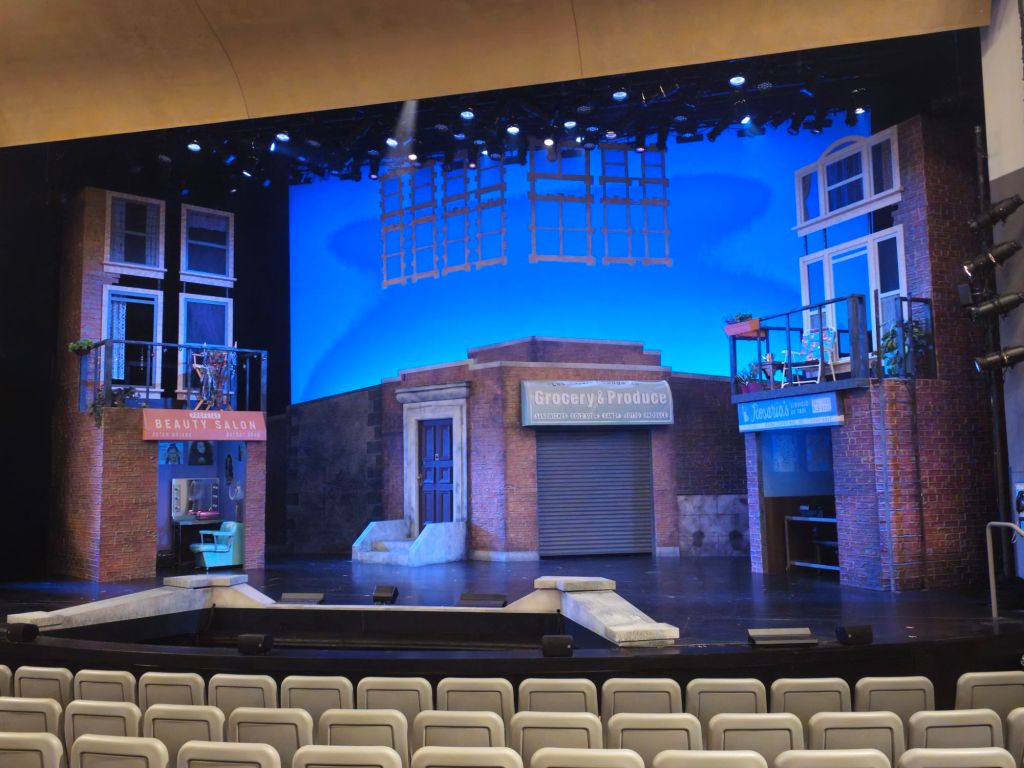
    The Tony-winning musical Kimberly Akimbo, with music by Jeanne Tesori and a book by David Lindsay-Abaire (based on his play) centers around Kimberly as a girl who grew up too fast while her family seems to not have grown up at all. Her father Buddy is an alcoholic man-child, her mother Pattie is an insecure and paranoid hypochondriac (not helped by being pregnant) and her aunt Debra is a chronic screw-up who is always in and out of prison and constantly thinking up new scams to run.  All the while, Kimberly is just trying to make it through high school where she predictably feels ostracized, although during the show she does find herself making a connection with the puzzle-obsessed Seth as they work on a school project together and eventually also a group of Show Choir needs who serve as something of a Greek chorus for the show while also navigating the various crushes they have on each other.

    All of these characters fit into a dynamic that is fairly familiar, almost bordering on sitcommy. Kimberly tries to get her parents to be more normal, she builds her friendship with Seth, and eventually Aunt Sylvia ropes her in to a check-washing scam. Meanwhile, there are family secrets and deep-seated insecurities at play that will inevitably get revealed. All of these individual parts are things we’ve seen before, but the writing of Lindsay-Abaire and Tesori’s delightful music, as well as the tonal control of director Jessica Stone are so deftly executed that you never lose the humanity during your laughter. A ton of credit also goes to the cast. Kimberly is played by stage veteran Ann Morrison (whose credits include the original Broadway run of Merrily We Roll Along) who is able to capture both the youth and vulnerability of the character beautifully.

    A key element of a character like Kimberly is that despite her physical aging and the fact that she often has to serve as a grounding rod for her own parents, she’s still a teenager, with all the insecurity and recklessness that comes with that. Her parents try to do their part, but tend to express themselves in the worst possible ways, often to hilarious effect. Jim Hogan as Buddy tries to be protective of Kimberly when he sees her obvious crush on Seth (Marcus Phillips), but as he escalates and escalates it becomes so over-the-top that he ends up scaring himself straight when he sees how upset Kimberly has become. Laura Woyasz as Pattie truly seems to enjoy being a mother, but ends up focusing almost all of her maternal instincts on her unborn child rather than Kimberly. She spends a lot of time recording video messages to her baby that seem to be as much for her, as she’s constantly reminding her future child to tell everyone she was a good person, so matter what anybody else tells them. Meanwhile, as Aunt Debra, Emily Koch drops into the story like a hand grenade, stealing almost every scene she’s in with expect comedic skill. Shamelessly vulgar and undeniably herself, you can see why people keep getting drawn to her despite her obvious shadiness.

    Kimberly in particular is drawn to Debra’s energy because the idea of living in the moment is particularly resonant for her. As much as Kimberly tries to be a normal teenager, she’s constantly being reminded of how little time she has left, and yet despite that the show is never depressing. Indeed, it is life-affirming, as we see Kimberly finally take advantage of her own time and live the life she wants to.

    Kimberly Akimbo is a musical for everyone who has felt like an outsider, for everyone who thinks they’re too different to fit in, and for anybody who thinks having a difficult personal or family life means they don’t deserve to be happy. A show like this shows the importance of finding your own happiness and how discovering your own strength can also help build up the people around you. It’s a wonderful show, filled with laughs, beautifully performed songs, and powerful performances from the entire cast.

    KIMBERLY AKIMBO plays at the Ordway Center for the Performing Arts through March 1st.

  • The Cottage is a relatively new play (it ran om Broadway in a 2023 production directed by Jason Alexander) but Sandy Rustin’s writing is very self-consciously reminiscent of the classic British sex farces of the 1930s and later – particularly the work of Noel Coward. Brainerd Community Theatre’s new production of the play, directed by Amy Borash, is a fast-paced and often very funny show held back slightly by flaws in the material that fall short of living up to its inspirations.

    The core story is as classic as it gets – two couples are, unbeknownst to each other, having affairs with the others’ spouses. The play opens withbSylvia (Rachel Kline) relishing the one day a year she spends at the titular Cottage with Beau (Matt Hill), brother of her husband. Beau seems quite satisfied with keeping the arrangement as-is, but Sylvia wants more and she horrifies Beau by revealing she has sent telegrams to her husband Clarke (Brian Rhett) and sister-in-law Marjorie (Abby Pratt) informing them of her intention to leave Clarke for him. Soon all four are at the Cottage together, where it is soon revealed that Clarke and the heavily pregnant Marjorie have also been sleeping together – and not just once a year.

    We get all of the expected confrontations, questions, accusations, and secrets, all played with a delightful parody of stereotypical English propriety. You can feel the personalities straining as each character tries to find a moral high ground in a story where nobody has been completely honest with anybody else. The screw turns tighter with the arrival of Dierdre (Natalie Topete), Beau’s other mistress, who informs the group she has just divorced her husband and fully expects him to arrive soon and murder Beau.

    Amy Borash is often at her best directorially when working with high energy or high tension, and there are some definite high points here, from the characters debating who is or is not at fault for the infidelities to a hilarious scene where Dierdre gets drunk while everyone else is discussing an inheritance to a sequence where Marjorie seems about to go into labor that ends in quite a different manner than you’re likely to expect coming in. Less effective are the expository speeches where characters talk about the events leading up to the story or the weirdly earnest scenes when the cast talks about the nature of love. These scenes do give the actors more to chew on, dramatically-speaking, but in terms of storytelling they mostly serve to slow down the pace.

    Thankfully, the cast is bringing all of the energy necessary for a madcap farce like this. I’m particularly happy to see Rachel Kline in a leading role again. She does a great job at finding layers in Sylvia as the show progresses, or even as Sylvia finds them in herself. It’s the sort of performance you’re always attuned to, no matter how chaotic the story around her gets. As Beau, Matt Hill spends most of the show ping-ponging between attentions to mistress, spouse, and family, even when it’s ultimately clear to the audience the only person he cares about is himself. It’s a wonderful performance, completely distinct from his previous performance in Dracula: a Comedy of Terrors.  Brian Rhett and Abby Pratt are always welcome presences, and here they serve an an effective grounding rod, given theirs are the only characters who know exactly what they want. As Dierdre, Natalie Topete is a delightful airhead and brings some hilarious and unexpected physical comedy to the mix.

    Also worth mentioning is the set. The characters often mention during the show how nice the cottage is, and set designer Tim Leagjeld has created a setting that more than lives up to the praise. It’s a gorgeous set, with not an inch wasted. There is even room for some amusing sight gags, such as the various hiding places for cigarettes found around the area.

    If you’re looking for a fun night at the theatre or just some anti-Valentine’s Day entertainment, The Cottage is definitely worth your time. Is the script as good as some of the classic British sex farces that it echoes? No, not necessarily, but it’s consistently funny, well-acted, and refreshingly adult-oriented. Check it out.

    THE COTTAGE runs through February 15 at the Chalberg Theatre at Central Lakes College.

  • On Golden Pond is one of those plays you might call a “community theatre classic”.  It’s a weepy without being a downer, sentimental, but still funny, and includes among its cast both a grumpy old man and a sneaky, precocious teen. What more could you ask for?

    The story, well worn and well-known, has the aged couple Norman Thayer, Jr and his wife Ethel come up to their summer home in rural Maine. Norman is the kind of of old man who constantly talks about his impending death while making it clear through his attitude that he has no intention of going too gentle into that good night. Ethel is sweeter and more grounded but (as can be best seen in a key scene involving their daughter Chelsea) far from a pushover. As is often the case with these sort of nostalgic trips, the couple reflect both on what’s changed and what’s stayed the same. Eventually they hear Chelsea is coming up to visit, giving a rare opportunity for a moment of connection between her and Norman before the end of what he seems convinced will he his final summer On Golden Pond.

    The performances are the reason you come to see a show like this, and director  Andrea Anderson has assembled a wonderful cast of local talent. Blake Lubinis is a much younger actor than you’d expect to be cast as Norman Thayer, but he handles the part very well, making him the sort who isn’t playful in spite of his grouchiness, but playful by way of his grouchiness. He has a ton of fun needling people, and while you can definitely sense the moments when he might have went too far, you also can’t blame him for still being unabashedly himself. I was initially a little jarred by Blake’s ‘old man’ voice until I realized what it reminded me of – he sounds uncannily like James Stewart. Now I get to imagine a version of On Golden Pond with Jimmy Stewart in the lead, and that’s delightful.

    Michelle McCaughtry as Ethel is perfectly cast, playing the part like the mother or grandmother you’ve always wanted. She’ll match Norman beat-for-beat while also serving as the ambassador of sorts between him and the rest of the world. This becomes particularly important when Chelsea (a wonderful Anne Freelove) comes, and you get the sense that as entertaining as Norman’s grouchiness might be for two hours on stage, being raised by that sort of personality could be rough. Their strained relationship is a tough sort of balancing act, as they know they both should love each other while also knowing Chelsea at least has very good reason for not liking Norman very much. Can you still love someone without liking them? Can he become her friend even though it might be too late to be her father? Lubinus and Freelove play out their dynamic wonderfully.

    Also featured in the cast are Ryan Veith as the big-hearted but none-too-bright local mailman and Steven Palmer as Chelsea’s new boyfriend Bill, who below his polite exterior is fully capable of standing up to Norman (you get the sense in this production that that may he what attracted her to him in the first place). Then there’s Samuel Freelove as Bill’s son Billy, who quickly becomes an unlikely friend to Norman because like Norman he has no patience for niceties. Sam brings the exact right attitude for the part, playing him as a kid whose attitude serves as a shield that he can lower once he realizes there’s something more to the old man than he expected.

    Director Andrea Anderson introducing the show on opening night

    I was a little confused by the set at first – the huge projection screen felt out of place towering over the house interior. I got used to it eventually, especially once the lighting effects (technical direction by Rob Freelove) allowed it to more properly look like the ever-changing sky. Add to that the occasional calls of loons and other nature sounds and the mood is set very nicely throughout. The whole show is very nice – just a good piece of community theatre. It’s funny, sweet, and well-acted. The sort of show where anyone could come and have a good time, even an old grump like Norman Thayer, Jr.

    On Golden Pond plays through January 18th at the CTC Center in Pillager

  • I was honored to vote on and help present the 11th Annual Twin Cities Theatre Bloggers Awards!

    Includes a cat cameo and a reminder why I’m more comfortable writing about theatre than speaking about it extemporaneously.

  • I’m proud to be a member of the Twin Cities Theatre Bloggers. This was my first year voting in their awards, and I’m very happy with the nominations and how they recognize the breadth of excellence that is theatre in Minnesota. Keep in mind these nominations are mostly limited to the Twin Cities area, and don’t forget there are plenty of excellent theater productions in Greater Minnesota as well.

    FAVORITE COMEDIC PERFORMANCE BY AN INDIVIDUAL
    Armando Harlow Ronconi – Singin’ in the Rain AND Waitress, Artistry MN
    Cherly Willis – Souvenir, Gremlin Theatre
    Kate Beahen – A Christmas Carol… More or Less, Yellow Tree Theatre
    Noah Hynick – Significant Other, Lyric Arts
    Sally Wingert – An Act of God AND It’s Only a Play, Six Points Theater and Park Square Theatre

    FAVORITE DRAMATIC PERFORMANCE BY AN INDIVIDUAL
    Amedia Pedlow – A Doll’s House, Guthrie Theater
    Bryce Michael Wood – Primary Trust, Guthrie
    Dustin Bronson – Misery, Yellow Tree
    Sushma Saha – Maybe You Could Love Me, Theater Mu
    Tracey Maloney – Cherry Orchard, The Jungle Theater and The Moving Company

    FAVORITE MUSICAL PERFORMANCE BY AN INDIVIDUAL
    Anna Hashizume – Grease AND My Fair Lady, Chanhassen Dinner Theatres and Theater Latté Da
    Em Adam Rosenberg – Whoa, Nellie!, History Theatre
    Erin Capello – Waitress AND Passion, Artistry and Theater Latte Da
    Jo Lampert – Cabaret, Guthrie
    Shinah Hey – Sweet Charity, Artistry

    FAVORITE COMEDIC PERFORMANCE BY AN ENSEMBLE
    It’s Only a Play, Park Square
    A Midsummer Night’s Dream, Guthrie
    The Nacirema Society, Guthrie
    Pride and Prejudice, Theatre in the Round
    This Girl Laughs, This Girl Cries, This Girl Does Nothing, Ten Thousand Things Theater

    FAVORITE DRAMATIC PERFORMANCE BY AN ENSEMBLE
    Between Riverside and Crazy, Park Square
    The Cherry Orchard, Jungle and Moving Company
    Come Back, Little Sheba, Dark & Stormy Productions
    The Mousetrap, Guthrie
    The Last Yiddish Speaker, Six Points

    FAVORITE MUSICAL PERFORMANCE BY AN ENSEMBLE
    Fun Home, Theater Latte Da
    Lizzie: A Rock Musical, Open Eye Theatre
    Natasha, Pierre, and the Great Comet of 1812, Theatre Elision
    Violet, Ten Thousand Things
    Waitress, Artistry
    Whoa, Nellie!, History Theatre

    FAVORITE DIRECTOR OF A PLAY
    Eric Morris – Love and Baseball, Artistry
    Joseph Haj – A Midsummer Night’s Dream, Guthrie
    Katie Bradley – Maybe You Could Love Me AND Stop Kiss, Theater Mu
    Penelope Parsons-Lord – Pride and Prejudice, Theatre in the Round
    Tracy Brigden – A Doll’s House AND The Mousetrap, Guthrie

    FAVORITE DIRECTOR OF A MUSICAL
    Joseph Haj – Cabaret, Guthrie
    Justin Lucero – My Fair Lady AND Passion, Theater Latte Da
    Laura Leffler – Sweet Charity AND Whoa, Nellie!, Artistry and History Theatre
    Lindsay Fitzgerald – Natasha, Pierre, and the Great Comet of 1812, Theatre Elision
    Michael Brindisi – Grease, Chanhassen

    FAVORITE MUSICAL DIRECTOR
    Amanda Weis – Lizzie AND Whoa, Nellie!, Open Eye and History Theatre
    Bradley Beahen – Waitress, Artistry
    Harrison Wade – Natasha, Pierre, and the Great Comet of 1812, Theatre Elision
    Jason Hansen – Fun Home AND Passion, Theater Latte Da
    Mark Hartman – Cabaret, Guthrie

    FAVORITE CHOREOGRAPHER
    Abby Magalee – My Fair Lady AND Sweet Charity, Theater Latte Da and Artistry
    Casey Sams – Cabaret, Guthrie
    Danny McHugh and Kelli Foster Warder – Singin’ in the Rain, Artistry
    Joey Miller – Whoa, Nellie!, History Theatre
    Tamara Kangas Erickson – Grease, Chanhassen

    FAVORITE OVERALL DESIGN
    Fun Home, Theatre Latte Da (Scenic Designer: Eli Sherlock, Costume Designer: Rich Hamson, Wig, Makeup, & Hair Designer: Emma Gustafson, Sound Designer: Katharine Horowitz, Lighting Designer: Alice Trent, Props Designer: Madelaine Foster)
    The Mousetrap, Guthrie (Scenic Designer: Walt Spangler, Costume Designer: Susan Tsu, Lighting Designer: Rui Rita, Sound Designer/Composer: John Gromada)
    Natasha, Pierre, and the Great Comet of 1812, Theatre Elision (Scenic Designer: Lindsay Fitzgerald, Lighting Designer: Laine Grendle)
    Paradise Blue, Penumbra Theatre Company (Scenic Designer: Maruti Evans, Lighting Designer: Marcus Dilliard, Sound Designer/Composer: Gregory Robinson, Costume Designer: Wanda Walden)
    Whoa, Nellie!, History Theatre (Scenic Designer: Joel Sass, Props Designer: Rebecca Jo Malmstrom, Costume Designer: Bryce Turgeon, Lighting Designer: Grant E. Merges, Sound Designer: C Andrew Mayer)

    FAVORITE PLAY
    Pride and Prejudice, Theatre in the Round
    Primary Trust, Guthrie
    The Rainmaker, Lyric Arts
    Somewhere, Guthrie
    Stop Kiss, Theater Mu

    FAVORITE MUSICAL
    Cabaret, Guthrie
    Lizzie: A Rock Musical, Open Eye
    Natasha, Pierre, and the Great Comet of 1812, Theatre Elision
    Waitress, Artistry
    Whoa, Nellie!, History Theatre

    FAVORITE NEW WORK
    Endometriosis: The Musical, Theatre in the Round
    Lesson in Love, Pillsbury House Theatre
    Maybe You Could Love Me, Theater Mu
    The Ruins, Guthrie
    Whoa, Nellie!, History Theatre

    FAVORITE THEATER COMPANY
    Artistry
    Lyric Arts
    Six Points Theater
    Ten Thousand Things
    Theater Latte Da

    FAVORITE THEATER VENUE
    The Crane Theater
    Gremlin Theatre
    The Hive Collaborative
    Open Eye Theatre
    Park Square Theatre

    FAVORITE EMERGING ARTIST
    Antonisia Collins
    Caitlin Sparks
    David Michaeli
    Jack Bechard
    Stephanie Kahle

    The winners will be announced soon on the YouTube page of The Stages of MN. Congratulations to all of the nominees!

  • I love cooking, especially weird stuff, and I also love pop culture, so naturally when the two intersect I’m pumped. Whether it is an anime like Food Wars or online cooking shows like Binging With Babish finding ways to try out new sorts of meals is always something I’m interested in, especially when it comes from unexpected places.

    So several years ago when I was watching some episodes of Dragnet 1967, I was dumbstruck when I saw a cold open that featured Harry Morgan’s Bill Gannon describe his secret barbecue sauce recipe to Jack Webb’s Joe Friday.

    It all starts out innocently enough… ketchup, mustard, onions, garlic, and vinegar are commonly found in barbecue sauce recipes. But vanilla ice cream? It might not actually be as silly as it seems. Almost every barbecue sauce contains a lot of sweeteners – usually molasses, but it could also be brown sugar, honey, there’s even a recipe from one of Snoop Dogg’s cookbooks for a barbecue sauce that contains apricot jam! Also since the sauce is being used for lamb that could play nicely, too, as lamb often pairs well with sweet flavors.

    In trying to recreate the recipe as-is, we’re going to rely on the dialogue as written as well as the items Gannon has on his desk. Right away we run into some problems, mostly in terms of measurement. In his little monologue, Bill Gannon uses at least three different units of measurements for his ingredients, including volume, container, and weight. Now obviously, the writers of this episode never expected somebody to try and recreate it – this is a comic relief scene, and I suspect this episode (The Big High) was front-loaded with comedy because the rest of the episode is a particularly heavy-handed anti-drug story with an ending that is one of the darkest of the entire series (ironically, the idea of barbecue sauce made with ice cream sounds like an idea someone would come up with while high, but oh well) So while we’re going to try and stay as true to the scene as possible, there are some moments where we’ll have to do some interpretation and substitution.

    Gannon also mentions “parts” as a unit of measurement when talking to himself. Note also what appear to be bottles of Tabasco and horseradish (?) that otherwise go mentioned

    The ketchup is easy enough. A quart of ketchup would be 32 ounces, which is your average good-sized bottle from the supermarket. After mixing up the ketchup in a chilled bowl, he says to add “one can of red pepper”, which is a little bit weird because later in the recipe he asks for “one pound diced red peppers – peeled”. So I’m going to guess he was referring to red pepper flakes. Now I like a bit of spice in my food, but I don’t want this to be unbearably hot, so for the “can” I’m going to use a small, 0.5 oz jar of flakes that can be found in any supermarket spice rack. Given we’re going to end up with well over a gallon of sauce, that should add heat without overwhelming everything else.

    Also presumably adding heat as well as other tangy flavors is the “can of hot mustard”. Now, he could theoretically be talking about a can of something like Colman’s Hot Mustard powder, but as you can see above, the prop department has given Harry Morgan what appears to be a jar of Grey Poupon. There doesn’t seem to be a hot mustard variant of Grey Poupon on the market today, so I went online to find a hot mustard in a similar-looking container. I settled on Lowensef, an extra-hot German mustard that comes in 9oz glass jars. I figure Bill Gannon would approve, as throughout the series his rather… exotic palate was a consistent source of comic relief, to the point where two of his sandwiches have been featured on the YouTube channel Sandwiches of History.

    Next he calls for a quart of vinegar. He doesn’t say which kind… most barbecue sauce recipes I’ve seen ask for apple cider vinegar, but the closest indication we get is what appears to be a bottle of clear liquid on his desk. The bottle actually looks more like one that would hold rice wine vinegar these days, but I’m just going to assume Gannon meant standard distilled vinegar, which like ketchup, can easily be purchased in 32 ounce bottles. This is followed by some vegetation: the aforementioned peeled and chopped red peppers, one small jar oregano (like the red pepper flakes I went with a 0.25 ounce jar from the supermarket so as not to risk overwhelming the sauce with the flavor of dried herbs) and four or five cloves of fresh garlic. And then what do you do?

    Since I don’t have an electric mixer big enough to fit the bowl, I’ll be using the whisk attachment for my immersion blender. Now, the next section requires some more interpretation. Gannon says to add “five chopped Bermuda onions” as you mix all of the other ingredients together. Bermuda onions were something mentioned in pop culture quite a bit at the time, but these days for a number of reasons their popularity has gone the way of Bermuda shorts. You can presumably still find them in certain places, but for an equivalent good-sized sweet onion with a somewhat flat shape, today I’m going to go with Vidalias.

    Top: Bermuda onions. Bottom: Vidalia onions from a local supermarket

    This is also as good a time as any to point out there’s no actual cooking involved in the making of this sauce. That’s the most curious part to me – more so than even the ingredients. If I were to try making a sauce with these ingredients I’d probably start by sautéeing the vegetables and garlic in a saucepan for a while, which would release some of the moisture and sugars inside, and then add the liquids and simmer until it has reduced and thickened. Also, since he wants the red peppers to be peeled, I’d prefer to roast them under my broiler until they get some char and then peel the skin away after that. But we’re trying to stay true to the scene, so no cooking – just mixing it all together in a chilled bowl. After all, as Bill says, “it’s how you put them together”. So what happens next? That’s right… we mix in Bill’s secret ingredient – one that he supposedly heard from an old chef friend. One quart of vanilla ice cream.

    I’ll say

    Now this brings up an unexpected problem. I bought some Breyer’s, and the case said it holds 1.5 quarts. But when I tried to measure out 32 ounces on my kitchen scale, the whole of the container didn’t reach that amount. Is this another example of shrinkflation in action, or is there something else going on? I dunno, so I’m probably going to end up eyeballing the amount. I’m also switching from the whisk to the actual immersion blender attachment to make sure everything is of an even consistency and there aren’t any errant chunks of vegetables floating around.

    Is it a secret ingredient, or a secret weapon? Only time can tell.

    Now that we’ve got the sauce settled, it’s time to move on to our protein. Given this recipe is all about the sauce, I’m not going to be too precious about the lamb – I’m going with a pre-seasoned lamb shank readily available from a nearby Wal-Mart. Since this is supposed to be served for a barbecue I’m going to be cooking in my portable grill with wood pellets for smoke. The punch line of the scene seems to be that Gannon uses this sauce because he doesn’t like the taste of lamb (“you put it on lamb, you never know it’s lamb!”). But I do like lamb, so we’ll have to see how it shakes out once the lamb is finished cooking.

    Lamb shanks after being smoked and slow cooked to 185° F

    Two shakes of a lamb’s tail later, the shanks are finished and resting, ready for the sauce. I was tempted to try basting the lamb in the sauce during the last part of the cooking process, but again, no mention of that in the episode so we’re going to use the sauce straight-up. We’ll have plenty of leftovers, though, so maybe I can save them to take another crack at it later

    Looks delicious, don’t it?

    Despite the rather unappetizing peach-pink color scheme, the actual flavor of the sauce is not bad at all.  The most prominent flavor is a sharp tang – the ketchup, vinegar, and mustard are certainly doing the work. There’s some heat, too, courtesy of the mustard and pepper flakes, but not overwhelmingly so. There is sweetness from the ice cream, but it’s mild and acts as a counter to the sharpness that comes from the rest of the ingredients. You don’t get any vanilla flavor at all. The barbecue sauces I was raised on and tend to use are very sugar-forward, so this was a nice contrast. If you’re more used to a more vinegar-based barbecue flavor like North Carolina style, you’ll probably dig this.

    Look upon my works ye mighty, and despair!

    I’m keeping a jar or two of this stuff around for further experimentation (not sure what else I’ll find a use of it for, but I’ll jolly well try) and that brings me to the major drawback of this recipe – there’s way too much of it. As I said before, you end up with well over a gallon of the stuff, so unless you’re grilling an entire rack of lamb or four or five legs/shanks, there’s no way you’ll be able to use it all. So if you want to try making the sauce yourself, I’d recommend cutting the recipe by at least half. Or maybe try adding a scoop or two of ice cream to your preferred barbecue sauce recipe in place of the other sweeteners.

    So yeah, that was a surprisingly successful dive into the world of recreating joke TV recipes. I’ll probably see what I can do to further refine this, and maybe try and track down some other recipes to experiment with in the future.

  • When the first Avatar movie was released, lots of people said it played like Star Wars for a new era. With Avatar: Fire and Ash, James Cameron shows the dynamic is much more akin to The Lord of the Rings, with an ever-expanding ensemble of characters working through their differences to find a way to overcome an existential threat.

    The movie picks up immediately after the conclusion of Avatar: the Way of Water (another way in which the movie echoes The Lord of the Rings) and for much of the first act, it feels like Part 2 to TWOW‘s Part 1. Thankfully I rewatched TWOW last night, so I had the movie fresh in my memory, but for others, especially those for whom this is their first Avatar, it could be difficult to catch up. Jake Sully, his family, and their new community are still reeling from the massive battle that concluded TWOW, with the Sullys in particular mourning the loss of the oldest son Neteyam. His younger sibling Lo’ak (Britain Dalton) blames himself for Neteyam’s death, and during one heartbreaking argument we see that Jake blames him, too.

    One thing that makes Fire and Ash distinctive compared to the other movies in the franchise is its greater focus on interpersonal conflicts. Protecting the family has always been at the core of Jake Sully’s drive, but a family constantly at war is sure to develop some issues, and we see some deep divides emerge. The cast does a terrific job of selling not just the conflicts but also the love that abides in spite of it. Zoe Saldaña is always good and is particularly effective here, which is nice considering she got the short end of the stick dramatically-speaking in TWOW. Sam Worthington has his best material yet and gives a genuinely great performance as Jake. The young actors (Britain Dalton, Jack Champion, Trinity Jo-Li Bliss, and Bailey Bass, alongside the not-young-but-still-terrific Sigourney Weaver) bring all of the energy and outsized emotions you’d expect from young people in such a situation. Jack Champion as Spider in particular finds himself at the center of some of the most emotionally wrenching moments of the franchise, and sells it wonderfully.

    The scope of the Pandora mythos is once again expanded and deepened, this time by showing more sociological differences between the different Na’vi clans, including a trader class who tries to stay politically neutral in the conflict between the humans & Na’vi and most importantly, a militant bandit clan called the Mangkwan, or Ash People. They are led by Varang, a fearsome, sadistic, and creepily sexy Na’vi woman played by Oona Chaplain in a great performance showing that Oona inherited her grandfather’s knack for expressive physical acting. While most Na’vi tribes find unity over their faith in Pandora’s binding spirit Eywa, the Mangkwan reject Eywa completely, owing to a painful past when their previous forest home was engulfed in flame. When, as Varang puts it, Eywa didn’t come to help, they decided to worship the destructive power of the flames instead, becoming a fearsome and hedonistic tribe of bandits.

    This lack of loyalty eventually leads Varang and her warriors into an unlikely alliance with Colonel Quaritch (Stephen Lang, stealing scenes the way he always does) who is still trying to hunt down Jake and Spider both for the Earth forces employing him and for personal reasons. This alliance becomes particularly important to Quaritch because his single-minded devoted to hunting them down becomes so single-minded that it brings him into conflict with his RDA superiors, who would prefer a more pragmatic approach because after all, they’re primarily there to make money and open war doesn’t help that very much. Lots of the returning human characters get more to do here, from Edie Falco as Quaritch’s military superior to Jermain Clement as a conflicted marine biologist. Even Giovanni Ribisi returns as the slimy business head with an amusing added twist where we find out that despite his position nobody respects him because he’s a nepo baby.

    James Cameron continues to find new ways to wow us visually, and despite not being able to see the movie in 3D, it was still dazzling. Some of the visual themes are similar to TWOW, admittedly, but there plenty of moments that are simply beautiful to look at. These are the sorts of movies that you can lose yourself in, and with the extended runtime and confident pacing, it really does feel like you’re escaping to another world. And then there are the action sequences, some intense and frightening while others are exhilarating. The epic conclusion at the end features sequences within sequences as all of the characters have a role to play in the battle, and you never lose track of anybody for too long.

    If you’re a fan of the Avatar franchise, Avatar: Fire and Ash delivers all of the gorgeous visuals, thrilling action, and resonant emotions you could ask for. It might feel like more of the same for some people, but if the same is still terrific, what’s there to complain about?

    Yes, the original song this time around is by Miley Cyrus. And it’s really good!
  • Theatre Latte Da continues their streak of smartly produced and impeccably acted interpretations of beloved musicals with My Fair Lady, a new production of Lerner & Lowe’s classic musical adaptation of Pygmalion. Director Justin Lucero brings a light touch that keeps the comedy moving quickly, but also knows when to slow down, allowing the characters to speak their minds whenever the show calls for it. My Fair Lady is a very funny musical, but Lucero and his cast also understand is has real things to say about identity & class and gender dynamics that are just as relevant today as they were in the Edwardian era where the show was originally set.

    Of course, any production of My Fair Lady lives and dies on casting, and this one has hit it out of the park. As Henry Higgins, Jon-Michael Reese gives one of the most delightful comedic performances I’ve seen in a long time. He positively vibrates with energy, seeming to bounce back and forth across Eli Sherlock’s set as Higgins formulates his plan to pull one over on London’s upper crust. Matching him beat for beat is Anna Hashizume as Eliza Doolittle. Hashizume, coming straight off her show-stealing performance as Rizzo in the Chanhassen Dinner Theatre’s Grease, brings the same energy as a tough, self-assured woman who is both smarter and more vulnerable than she initially appears. The battle of wits between these two headstrong personalities is the heart of any production of My Fair Lady, and you can feel the fun the actors are having as Higgins tries to reshape the lower-class flower girl Eliza into a Lady, while Eliza tries to make it through Higgins’ lessons without losing herself to them.

    And if those two weren’t enough on their own (and they would be), My Fair Lady also has a slew of delightful supporting characters, all of whom are cast terrifically. The always reliable Tod Peterson plays Colonel Pickering, a more warm and personable contrast to Higgins’ detached and self-centered approach. Adán Varela as Eliza’s father Alfred Doolittle is a delightful oaf, drifting from pub to pub and living off of what he can grift from others because, as he puts it, he “can’t afford” morals and is perfectly content that way. Then on the other side of the class divide we have Norah Long as Henry Higgins’ mother, who is perhaps even more exasperated by him than Pickering and Eliza. When Higgins brings Eliza to his mother’s box at the Ascot races in his first test to see if she can pass herself off as a Lady, Eliza instead manages to ingratiate herself by allowing her real personality to come through. Hashizume’ comedy chops really shine in these scenes, and we can see why the young aristocrat Freddy Eynsford-Hill (Felix Aguilar Tomlinson) immediately becomes drawn to her. In fact, it soon becomes clear that Eliza is more welcome in these circles than Henry himself, whose coarse personality and arrogance immediately turn people off. It’s another way the story illustrates the artificial nature of the class divide – when something as simple as an accent keeps people apart who might otherwise enjoy each others’ company, of what use is the barrier?

    Class distinctions are felt at every layer in this production – even the instrumentation! The music in this production was newly arranged for two pianos by Trude Rittman, with conductor Joshua Burniece in formalwear playing on a grand piano while Wesley Frye wears more casual dress on a smaller piano. Both musicians are on stage for the entire show, sometimes even interacting with the cast. It’s an inspired choice, and one that shows a smart director can always find new ways to showcase a musical’s ideas, even into the music.

    Justin Lucero’s program note further details the relevance of the material.

    And what music! My Fair Lady contains some of the catchiest and most enjoyable songs in the classic musical theatre catalogue. Anna Hashizume gets to show off her range, from the more conventional “Wouldn’t it be Loverly” (which is, indeed very lovely) to breaking out her operatic voice for “I Could Have Danced All Night”. Jon-Michael Reese throws himself into a series of solos like “I’m an Ordinary Man” and “A Hymn to Him” that sometimes play more as soliloquies than songs but allow him to use every tool from his comedic toolbox to great effect, and Felix Aguilar Tomlinson just about brings the house down with his performance of “On the Street Where You Live” (a song that’s a personal favorite).

    The second act of the show shifts away from the comedy of the earlier scenes to show just how out of place Eliza feels. She can pass herself off as Lady, but now what? She can’t go back to her previous life, but she won’t be comfortable faking her way into a new one, either. It’s something that hadn’t occurred to Higgins – in fact he has so enjoyed spending this time with Eliza that he never thought that there might be a time when she wasn’t around anymore, and he can’t find a way to express those feelings to her without hurting her even more. This shift from comedy to drama might not work in less accomplished hands, but Justin Lucero makes sure everything feels real, and the chemistry of Reese and Hashizume makes their characters’  divide all the more painful. Higgins thought his role the whole time was to teach Eliza without realizing she had just as much to offer him. When Eliza demonstrates Henry’s inability to understand it during “Without You”, it’s a moment of triumph for her, but also one with a bittersweet pang, because there was a true potential for friendship there. We have little doubt that Eliza will end up on her feet, but by the end all Henry has are memories of what might have been.

    MY FAIR LADY plays at Theatre Latte Da through December 28th

  • The main reason most people give for seeking out entertainment is “escapism”, that is, finding a story or experience that you can lose yourself in as a way from getting away from the troubles of the real world, at least for a few hours. Teatro Del Pueblo’s production of Kander & Ebb’s Kiss of the Spider Woman is a show that challenges the very notion of escapism, asking what role escape has in an increasingly perilous world, and whether the sort of person who would prefer to escape rather than engage would make other moral compromises to preserve their own safety as well.

    The musical, written by Terrence McNally from the novel by Manuel Puig (previously adapted into the Oscar-winning 1985 film) follows two men as they share a cell in a brutal South American prison. Valentin is a revolutionary, imprisoned for passing along passports. Molina was convicted of “public indecency”, essentially for the crime of being openly queer.


    Both Valentin and Molina are trying desperately to survive, in very different ways. Valentin wishes to keep his head down, avoid giving in, and do his best to live through the tortures forced on him by the prison warden. Molina, by contrast, survives through movies. Not real movies – memories of them. Molina’s beloved mother was an usherette at a theater, which gave him the opportunity to see all of the movies that were playing, and he became particularly enamored by the movie star Aurora, who led the sort of technicolor epics that used to play on regular rotation on TCM. He loves to tell and retell the stories, even when Valentin has no interest in listening.

    This is because Molina is mostly escaping into his mind. But even his memories and imagination are not a fully safe space… among the musicals, romances, and historical adventures there is one more movie Aurora starred in: a Gothic tale about a fearsome Spider woman who kills all men she encounters, and she represents the ever-present threat of death that Molina can never truly escape.


    Molina is played by Zakary Thomas Morton, and they give a magnificent performance. Appearing a bit mannered at first, once they start to bond with Valentin (Silvestrey P’orantes) you see all of the dimensions of the character start to emerge. Molina’s flamboyance and tendency to respond to everything with a joke isn’t an act, but it is a defense mechanism. Valentin by contrast is very self-serious and devoted to his cause, but eventually Molina’s charms start to chip away at his defenses and he starts to open up. But lest you think this is yet another story of a straight man learning more about himself through bonding with a queer person, the show makes it clear their relationship is a lot more complicated than that. Molina’s feelings for Valentin are genuine – and romantic. But we also see that Molina is being used by the warden (an intimidating Justin Cervantes) to try and get information out of Valentin. Molina doesn’t want to put himself at risk but he doesn’t want to put Valentin at risk either, but in order to survive sometimes he has no choice but to do both. In Molina’s own words, they’re “a coward”, and you get the sense that they envy Valentin’s strength and devotion. Maybe that’s another reason Molina likes to escape into their memories of Aurora.


    Aurora is played by Maria Isabel, and she’s clearly relishing the opportunity to create a character that is literally iconic. She knows exactly which version of Aurora to play at any given time, from vamping it up in the more comedic numbers to playing up the romantic melodrama as a Russian noblewoman trying to save her love, to becoming truly intimidating and frightening when she plays the Spider Woman. Her scenes by design feel separate from the rest of the show, but you also feel the impact they have on Molina and, eventually, Valentin. But there are also moments when the reality begins to fray – a prisoner caught while escaping is shown getting stuck in the Spider Woman’s web (very effective set and lighting design by Jacelyn Stewart and Bill Larsen, respectively) and later when Molina is sent to the infirmary after ingesting poison meant for Valentin, the Spider Woman begins to stalk him, reminding Molina that death could get to him at any moment.


    The infirmary sequence in particular (“Morphine Tango”) is one of the high points of both Morton’s performance and the show as a whole, with great work by the ensemble as doctors literally spinning Molina around the stage on a gurney as they administer the morphine and cocaine that lead to Molina’s hallucinations. Zakary Thomas Morton’s physicality is impeccably well done here, showing both the character’s pain and their fear. Molina’s character dominates the show so much in these scenes that Valentin almost begins to fade into the background (I recall the 1985 film having more balance between William Hurt and Raul Julia), at least until Silvestrey P’orantes gets a showcase number with “The Day After That”, showing the revolutionary fervor and desire for freedom that drives him. Molina (and the audience) gets caught up in the moment just like he would in his memories of Aurora, and he begins to understand why someone like Valentin would risk everything, and see that with a big enough dream, risk can be its own reward.


    Alberto Justiniano’s direction pumps up the tension relentlessly and uses the set pieces and lighting to create the different parts of the prison very well, but the sound design is less effective. The orchestra being entirely placed on the right side of the set creates an imbalance, and at times the actor’s mics crackled or faded in and out, especially during the group scenes.
    Kiss of the Spider Woman is a powerful piece of entertainment that shows the need for humanity in a world full of oppression. It shows the importance of relationships and how bonding with others creates new, even unexpected sources of strength. This is an incredibly well-acted and directed musical that should absolutely be seen, and I hope it isn’t swallowed up by the bigger shows currently playing this season.

    KISS OF THE SPIDER WOMAN plays at The Southern Theatre through November 23