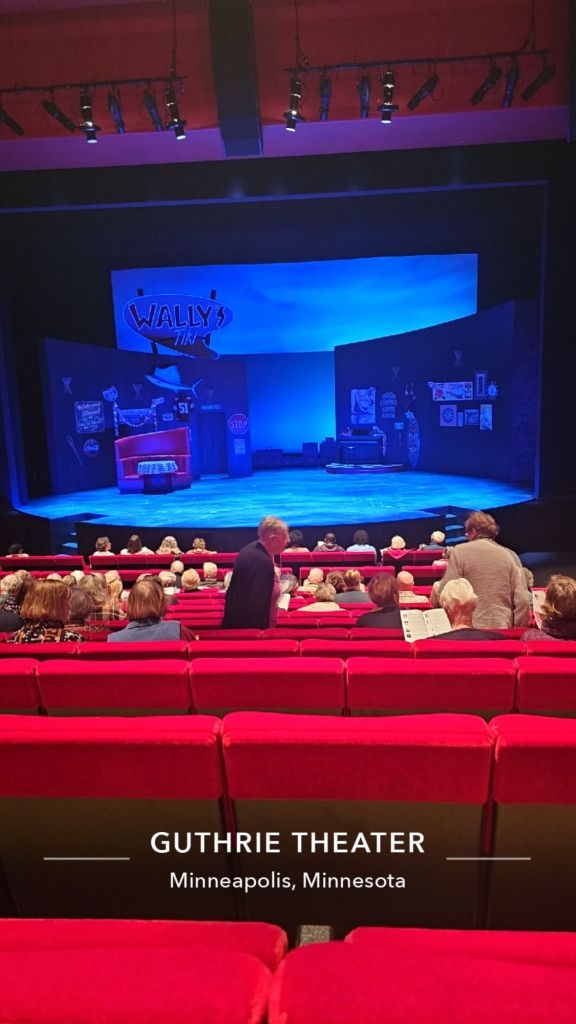
• Theatre Latte Da continues their streak of smartly produced and impeccably acted interpretations of beloved musicals with My Fair Lady, a new production of Lerner & Lowe’s classic musical adaptation of Pygmalion. Director Justin Lucero brings a light touch that keeps the comedy moving quickly, but also knows when to slow down, allowing the characters to speak their minds whenever the show calls for it. My Fair Lady is a very funny musical, but Lucero and his cast also understand is has real things to say about identity & class and gender dynamics that are just as relevant today as they were in the Edwardian era where the show was originally set.

    Of course, any production of My Fair Lady lives and dies on casting, and this one has hit it out of the park. As Henry Higgins, Jon-Michael Reese gives one of the most delightful comedic performances I’ve seen in a long time. He positively vibrates with energy, seeming to bounce back and forth across Eli Sherlock’s set as Higgins formulates his plan to pull one over on London’s upper crust. Matching him beat for beat is Anna Hashizume as Eliza Doolittle. Hashizume, coming straight off her show-stealing performance as Rizzo in the Chanhassen Dinner Theatre’s Grease, brings the same energy as a tough, self-assured woman who is both smarter and more vulnerable than she initially appears. The battle of wits between these two headstrong personalities is the heart of any production of My Fair Lady, and you can feel the fun the actors are having as Higgins tries to reshape the lower-class flower girl Eliza into a Lady, while Eliza tries to make it through Higgins’ lessons without losing herself to them.

    And if those two weren’t enough on their own (and they would be), My Fair Lady also has a slew of delightful supporting characters, all of whom are cast terrifically. The always reliable Tod Peterson plays Colonel Pickering, a more warm and personable contrast to Higgins’ detached and self-centered approach. Adán Varela as Eliza’s father Alfred Doolittle is a delightful oaf, drifting from pub to pub and living off of what he can grift from others because, as he puts it, he “can’t afford” morals and is perfectly content that way. Then on the other side of the class divide we have Norah Long as Henry Higgins’ mother, who is perhaps even more exasperated by him than Pickering and Eliza. When Higgins brings Eliza to his mother’s box at the Ascot races in his first test to see if she can pass herself off as a Lady, Eliza instead manages to ingratiate herself by allowing her real personality to come through. Hashizume’ comedy chops really shine in these scenes, and we can see why the young aristocrat Freddy Eynsford-Hill (Felix Aguilar Tomlinson) immediately becomes drawn to her. In fact, it soon becomes clear that Eliza is more welcome in these circles than Henry himself, whose coarse personality and arrogance immediately turn people off. It’s another way the story illustrates the artificial nature of the class divide – when something as simple as an accent keeps people apart who might otherwise enjoy each others’ company, of what use is the barrier?

    Class distinctions are felt at every layer in this production – even the instrumentation! The music in this production was newly arranged for two pianos by Trude Rittman, with conductor Joshua Burniece in formalwear playing on a grand piano while Wesley Frye wears more casual dress on a smaller piano. Both musicians are on stage for the entire show, sometimes even interacting with the cast. It’s an inspired choice, and one that shows a smart director can always find new ways to showcase a musical’s ideas, even into the music.

    Justin Lucero’s program note further details the relevance of the material.

    And what music! My Fair Lady contains some of the catchiest and most enjoyable songs in the classic musical theatre catalogue. Anna Hashizume gets to show off her range, from the more conventional “Wouldn’t it be Loverly” (which is, indeed very lovely) to breaking out her operatic voice for “I Could Have Danced All Night”. Jon-Michael Reese throws himself into a series of solos like “I’m an Ordinary Man” and “A Hymn to Him” that sometimes play more as soliloquies than songs but allow him to use every tool from his comedic toolbox to great effect, and Felix Aguilar Tomlinson just about brings the house down with his performance of “On the Street Where You Live” (a song that’s a personal favorite).

    The second act of the show shifts away from the comedy of the earlier scenes to show just how out of place Eliza feels. She can pass herself off as Lady, but now what? She can’t go back to her previous life, but she won’t be comfortable faking her way into a new one, either. It’s something that hadn’t occurred to Higgins – in fact he has so enjoyed spending this time with Eliza that he never thought that there might be a time when she wasn’t around anymore, and he can’t find a way to express those feelings to her without hurting her even more. This shift from comedy to drama might not work in less accomplished hands, but Justin Lucero makes sure everything feels real, and the chemistry of Reese and Hashizume makes their characters’  divide all the more painful. Higgins thought his role the whole time was to teach Eliza without realizing she had just as much to offer him. When Eliza demonstrates Henry’s inability to understand it during “Without You”, it’s a moment of triumph for her, but also one with a bittersweet pang, because there was a true potential for friendship there. We have little doubt that Eliza will end up on her feet, but by the end all Henry has are memories of what might have been.
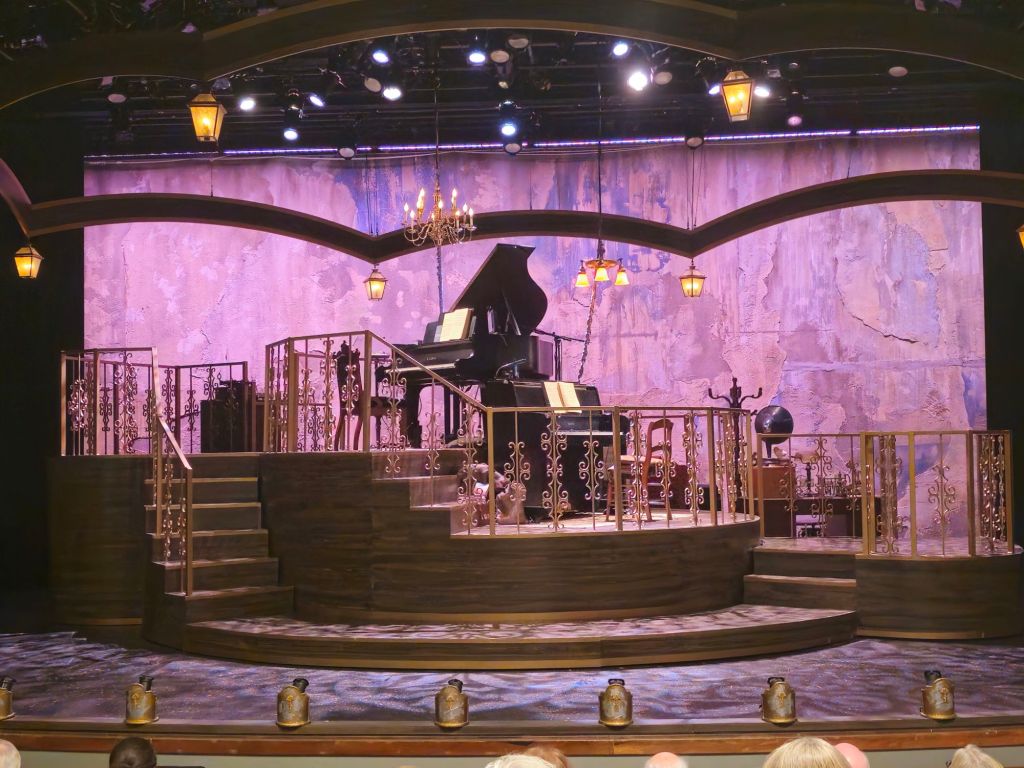
    MY FAIR LADY plays at Theatre Latte Da through December 28th
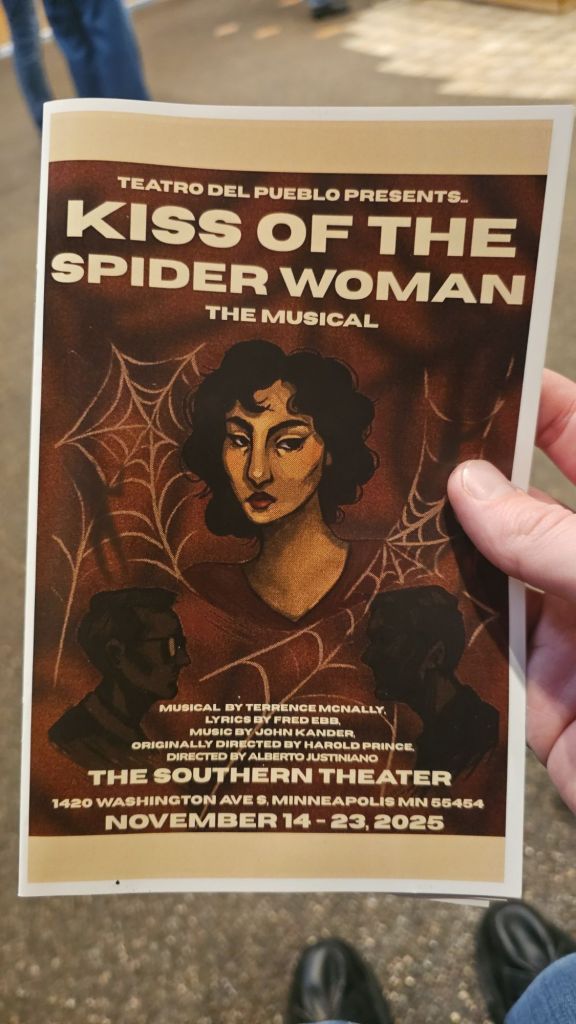
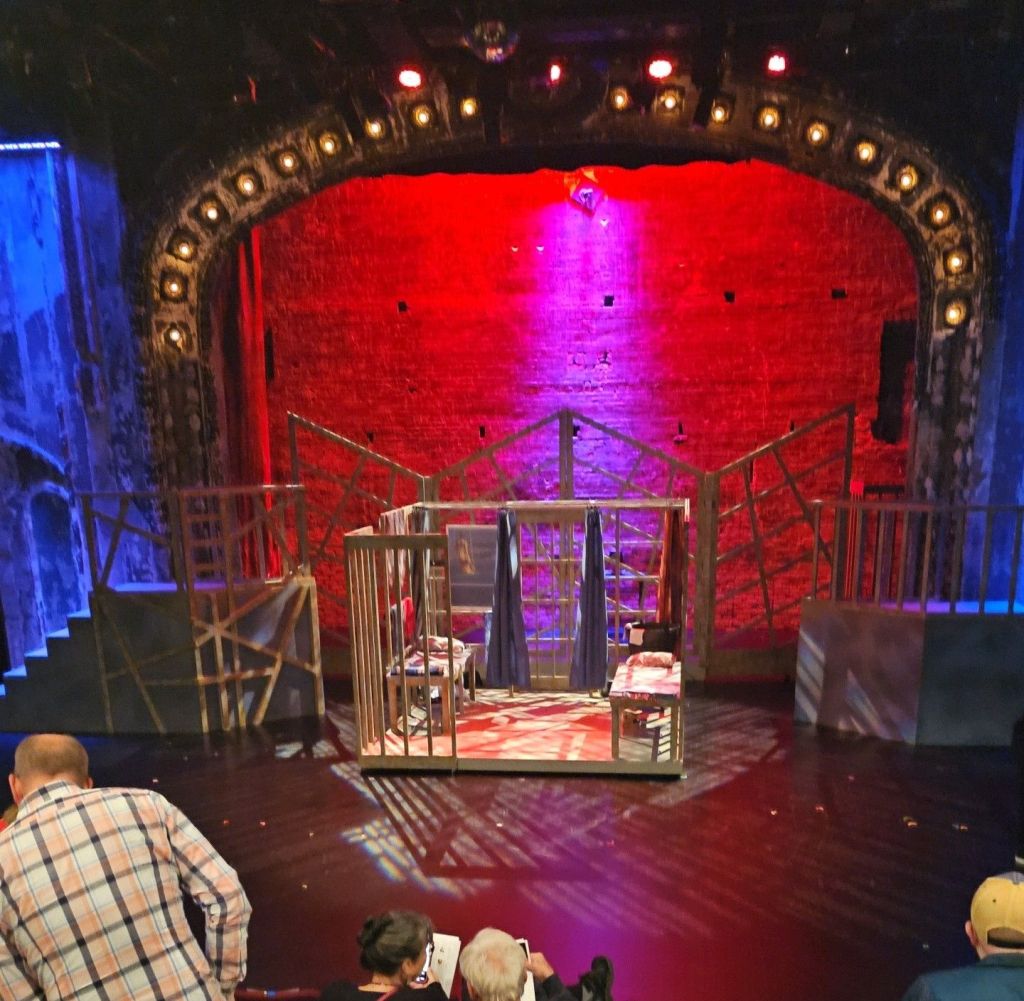
  • The main reason most people give for seeking out entertainment is “escapism”, that is, finding a story or experience that you can lose yourself in as a way from getting away from the troubles of the real world, at least for a few hours. Teatro Del Pueblo’s production of Kander & Ebb’s Kiss of the Spider Woman is a show that challenges the very notion of escapism, asking what role escape has in an increasingly perilous world, and whether the sort of person who would prefer to escape rather than engage would make other moral compromises to preserve their own safety as well.

    The musical, written by Terrence McNally from the novel by Manuel Puig (previously adapted into the Oscar-winning 1985 film) follows two men as they share a cell in a brutal South American prison. Valentin is a revolutionary, imprisoned for passing along passports. Molina was convicted of “public indecency”, essentially for the crime of being openly queer.


    Both Valentin and Molina are trying desperately to survive, in very different ways. Valentin wishes to keep his head down, avoid giving in, and do his best to live through the tortures forced on him by the prison warden. Molina, by contrast, survives through movies. Not real movies – memories of them. Molina’s beloved mother was an usherette at a theater, which gave him the opportunity to see all of the movies that were playing, and he became particularly enamored by the movie star Aurora, who led the sort of technicolor epics that used to play on regular rotation on TCM. He loves to tell and retell the stories, even when Valentin has no interest in listening.

    This is because Molina is mostly escaping into his mind. But even his memories and imagination are not a fully safe space… among the musicals, romances, and historical adventures there is one more movie Aurora starred in: a Gothic tale about a fearsome Spider woman who kills all men she encounters, and she represents the ever-present threat of death that Molina can never truly escape.


    Molina is played by Zakary Thomas Morton, and they give a magnificent performance. Appearing a bit mannered at first, once they start to bond with Valentin (Silvestrey P’orantes) you see all of the dimensions of the character start to emerge. Molina’s flamboyance and tendency to respond to everything with a joke isn’t an act, but it is a defense mechanism. Valentin by contrast is very self-serious and devoted to his cause, but eventually Molina’s charms start to chip away at his defenses and he starts to open up. But lest you think this is yet another story of a straight man learning more about himself through bonding with a queer person, the show makes it clear their relationship is a lot more complicated than that. Molina’s feelings for Valentin are genuine – and romantic. But we also see that Molina is being used by the warden (an intimidating Justin Cervantes) to try and get information out of Valentin. Molina doesn’t want to put himself at risk but he doesn’t want to put Valentin at risk either, but in order to survive sometimes he has no choice but to do both. In Molina’s own words, they’re “a coward”, and you get the sense that they envy Valentin’s strength and devotion. Maybe that’s another reason Molina likes to escape into their memories of Aurora.


    Aurora is played by Maria Isabel, and she’s clearly relishing the opportunity to create a character that is literally iconic. She knows exactly which version of Aurora to play at any given time, from vamping it up in the more comedic numbers to playing up the romantic melodrama as a Russian noblewoman trying to save her love, to becoming truly intimidating and frightening when she plays the Spider Woman. Her scenes by design feel separate from the rest of the show, but you also feel the impact they have on Molina and, eventually, Valentin. But there are also moments when the reality begins to fray – a prisoner caught while escaping is shown getting stuck in the Spider Woman’s web (very effective set and lighting design by Jacelyn Stewart and Bill Larsen, respectively) and later when Molina is sent to the infirmary after ingesting poison meant for Valentin, the Spider Woman begins to stalk him, reminding Molina that death could get to him at any moment.


    The infirmary sequence in particular (“Morphine Tango”) is one of the high points of both Morton’s performance and the show as a whole, with great work by the ensemble as doctors literally spinning Molina around the stage on a gurney as they administer the morphine and cocaine that lead to Molina’s hallucinations. Zakary Thomas Morton’s physicality is impeccably well done here, showing both the character’s pain and their fear. Molina’s character dominates the show so much in these scenes that Valentin almost begins to fade into the background (I recall the 1985 film having more balance between William Hurt and Raul Julia), at least until Silvestrey P’orantes gets a showcase number with “The Day After That”, showing the revolutionary fervor and desire for freedom that drives him. Molina (and the audience) gets caught up in the moment just like he would in his memories of Aurora, and he begins to understand why someone like Valentin would risk everything, and see that with a big enough dream, risk can be its own reward.


    Alberto Justiniano’s direction pumps up the tension relentlessly and uses the set pieces and lighting to create the different parts of the prison very well, but the sound design is less effective. The orchestra being entirely placed on the right side of the set creates an imbalance, and at times the actor’s mics crackled or faded in and out, especially during the group scenes.
    Kiss of the Spider Woman is a powerful piece of entertainment that shows the need for humanity in a world full of oppression. It shows the importance of relationships and how bonding with others creates new, even unexpected sources of strength. This is an incredibly well-acted and directed musical that should absolutely be seen, and I hope it isn’t swallowed up by the bigger shows currently playing this season.

    KISS OF THE SPIDER WOMAN plays at The Southern Theatre through November 23

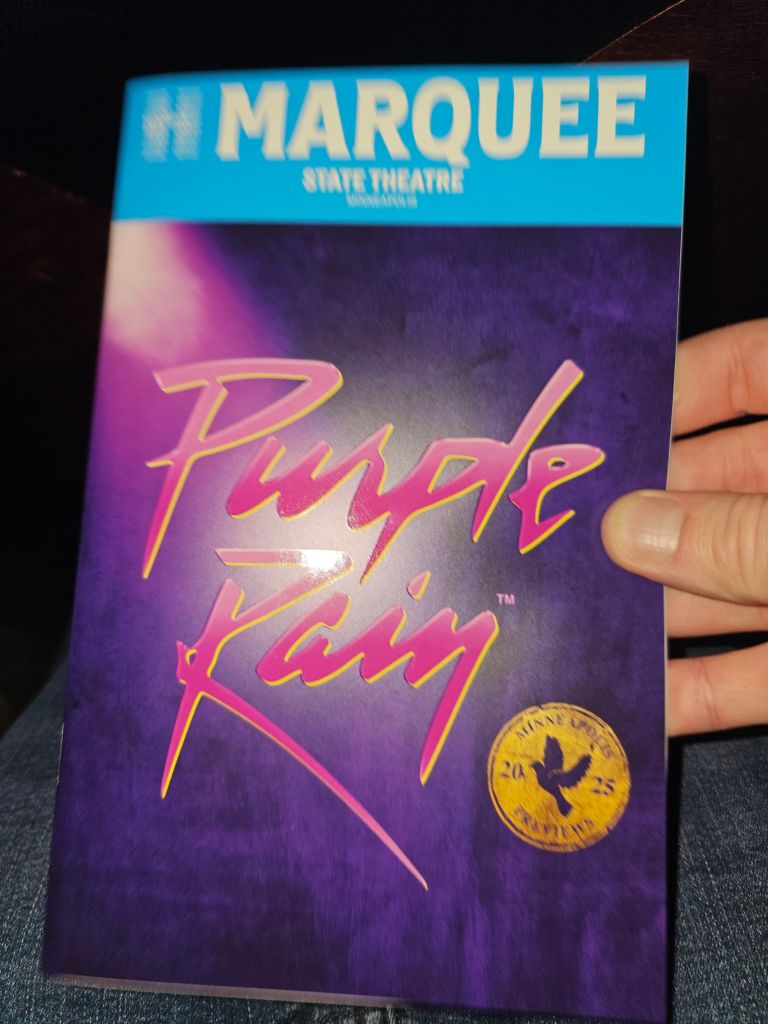
  • As a vehicle for talented performers to cover a lot of Prince’s greatest songs, Purple Rain works. As a story about a young musician striving to define himself amongst sterility, unresolved emotional issues, and romantic pain the show is too unfocused and makes too many strange storytelling decisions to really succeed as a drama.

    There are elements of the show that work but they are overshadowed by a book by the usually excellent Branden Jacobs-Jenkins (Tony winner for Appropriate and Pulitzer winner for Purpose) that has too many things on its mind to really be able to say anything about them. I had heard the show had issues with its book before I saw it, but I had assumed this was a similar issue that the also reliably talented playwright Lynn Nottage had when scripting MJ, but while that show had its drama compromised by an unwillingness to show its subject in anything but a sympathetic light, Purple Rain goes in the opposite direction – The Kid (the character is not Prince, it should be made clear) is such an impetuous jerk for so much of the show that it’s difficult to buy his redemption by the end.


    The 1984 movie from which this show takes its inspiration had similar issues, but in that case it had Prince’s own charisma and screen presence to help counter some of the unlikeable elements of the character. The superstar admittedly was not much of an actor, so while he fared well at portraying the tortured artist side of The Kid, his romantic scenes opposite Apollonia felt mostly limp. Playing The Kid on stage, Kris Kollins (a musician and vocal artist making his professional acting debut) by contrast, has a very sweet romantic chemistry with Rachel Webb’s (best known for her role as Juliet in the national tour of & Juliet) Appolonia, and the early scenes between the two of them where they share their love of music and create songs together are some of the show’s highlights. Director Lilena Blain-Cruz and choreographer Ebony Williams incorporate ensemble dancers into a love scene set to “Electric Intercourse”, creating on stage the feeling of a montage of the characters singing, composing, and making love over the course of several days. It’s a beautiful sequence, and contains the sort of purely theatrical magic that is missing from the rest of the production.


    These romantic scenes are so lovely that it makes it an even greater shame that most of the show’s story is devoted to the tortured artist side of The Kid, which Kollins isn’t able to handle as well. His efforts at playing that archetype come across instead as being more of a petulant, well… kid. Perhaps realizing that no actor could live up to Prince’s vibe, Jacobs-Jenkins’ book places an emphasis on the youth of its main cast, showing them as a group of young people trying to find their way in the world. How young they are isn’t specified (it’s implied they are college-aged) and that lack of specificity also applies to the setting. The show is set, as the movie was, at the First Avenue Club in Minneapolis, but the time period is a little bit nebulous. The characters have dialogue written with modern slang and sensibilities that wouldn’t fit with the film’s 1984 setting, but there’s no mention of the internet and a key plot point involves a TV special being filmed at the First Avenue, something that would seem outdated in a modern-day story. The First isn’t portrayed as being a jumping-off point for stars the way it was in the film, either – it’s just another music club, albiet one occasionally visited by talent scouts. A key point of conflict between The Kid and Appolonia is that she wants to go to New York to become a star, while he’s content to stay in Minneapolis and play his music at The First. This is one of the factors that leads to their split and Appolonia joining a girl group managed by The Kid’s professional rival Morris (Jared Howelton, giving an absolutely hilarious performance). That sense of double-betrayal sends The Kid into a spiral and he tries to channel his emotion into a series of uncomfortably raw live performances at The First, first his desire with “Beautiful Ones” and then his rage with “Darling Nikki”, and in neither case does he get the response he hopes for.


    The live performances are another highlight of the show. The cast performs them beautifully, and the stagecraft is full of flashy lighting effects and energetic choreography. The audience around me often reacted as if they were at an actual concert. Rachel Webb gets some standout numbers at the lead of the Appolonia Six (which is later renamed The Six, a choice which distractingly made me think of the musical Six) and Jared Howelton, while not as magnetic as Morris Day in the film, is still a very funny and game performer who shows the audience why he’s a strong rival for The Kid.


    The sets and costumes are all very well-crafted, illustrating the settings and heling define the characters. The audience gets a good laugh out of The Kid’s incredibly purple apartment, and there are a couple scenes where The Kid or Appolonia come out onto the performance stage wearing puffy fur coat whose purpose is seemingly only to create a shock when they take it off during their performance to show the skimpier outfit they have underneath.


    For a lot of people, I imagine the musical performances and slick technical elements will be enough, but for a two-and-a-half hour long show with most tickets being sold at prices of several hundred dollars, I don’t think it’s unfair to expect a story worth caring about or characters with depth. There are attempts at exploring what happens when an artist beset by trauma alienates those who are trying to help him, but that’s dealt with primarily way of awkwardly expositional dialogue (especially in the early scenes). We also get flashbacks to the abusive relationship between The Kid’s parents through use of projections, and a complicated portrait of The Kid’s relationship with his father (Leon Addison-Brown). The fact that The Kid’s father becomes a key supporting character in the second act while his mother is left completely off-stage except for a single (projected) phone call is another odd choice – granted, the movie also humanized the father while downplaying the mother, but you’d expect a writer like Branden Jacobs-Jenkins, who is normally so good at exploring complicated family dynamics, to put in more effort at exploring that relationship beyond The Kid feeling conflicted about having to financially support his father while also being scared that his own life will mirror his father’s failures as a musician and husband.


    The cast in general seems more comfortable with the comedic scenes, which offer welcome relief from the melodrama at the show’s core. Aside from the aforementioned Jared Howelton, Jaci Calderon, Christina Jones, and Lawrence Gilyard, Jr all give very funny supporting performances. Perhaps leaning more into the comedy would be a better idea for the show moving forward. It doesn’t have to be a full-blown parody, but playing the familiar tropes of the tortured but talented artist with a difficult family life with more self-awareness could make the story more entertaining and allow Kris Kollins to showcase more of the charm he shows in his early scenes with Rachel Webb. Purple Rain has potential, and Prince’s music remains undeniable, but I do think more work has to be done on the story and characters in order to make the production truly sing.

    PURPLE RAIN plays at the State Theatre through November 23

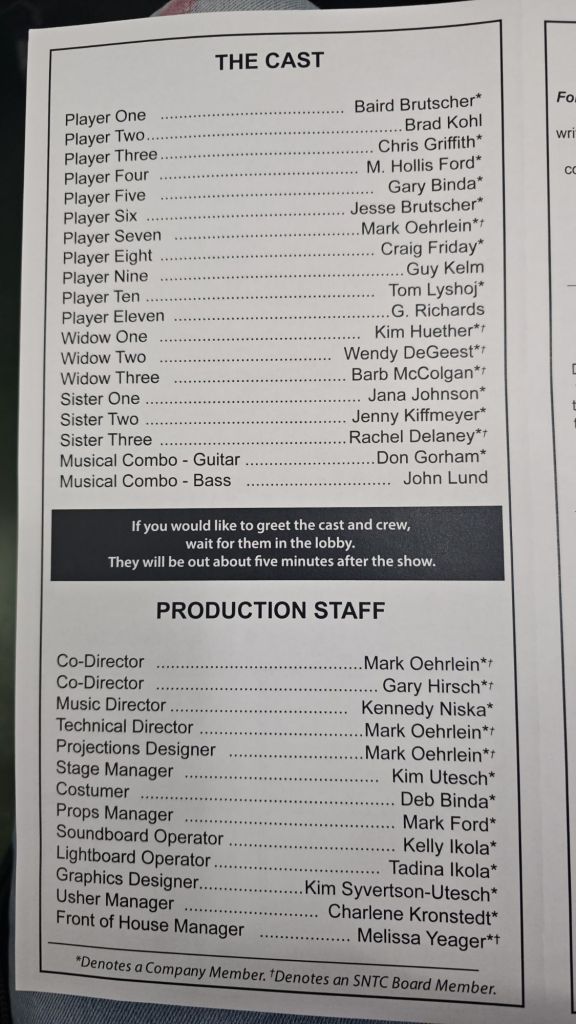
  • 10 November is a difficult sort of stage production to review, because it doesn’t feel like a conventional play or musical. The show (written by Steven Dietz with music by Eric Peltoniemi) is loosely structured with a series of vignettes alternated with songs, having more of the feel of a memorial service. That is appropriate, as the show’s purpose is to commemorate the memories of the 29 men who lost their lives in the wreck of the SS Edmund Fitzgerald 50 years ago.

    Stage North Theatre’s production, directed by Mark Oehrlein and Gary Hirsch, is a portrait of the disaster depicted as a collage of memories, reenactments, proverbs, and dreams. Some portions are taken from the historical record, others are dramatized, but they all serve to illustrate not just the lives lost, but the world they came from and the people who remember them. Although billed as a docudrama of sorts, 10 November isn’t an exposé or an investigative procedural. It wants answers, but knows that it probably can’t find them. In that way it is an effective portrayal of grief. In the wake of tragedy, you look wherever you can for an explanation. Even if you aren’t able to get the answer you want, the search can at least give you a greater understanding, and sometimes that’s the best you can ask for.

    A show like this depends on a well-balanced ensemble of actors, and as is always the case Stage North delivers. The fourteen actors and three singers all work together to embody the wide-ranging cast of characters, with none overshadowing the others. Whether they’re testifying before an investigative body, musing about ship life, or just shooting the shit with each other, the sense is the same: these are ordinary people, doing their jobs. We get a great sense of the culture of maritime life on the Great Lakes, and how those cultural norms played a role in the leadup to the wreck. In many ways, the men on the ships are caught between two irresistible forces – the need to deliver for their bosses (who often could care less about the well-being of their men if profits are at stake) and the lake itself, which is seen in almost godlike terms, something to be viewed with respect and awe precisely because it could end your life at any moment. The waves and storms that come from Lake Superior are portrayed as so perilous that it’s a wonder there are people for whom going out there is their everyday job. That underlines the tragedy – these men, ordinary people like you and me, took it upon themselves to do the sort of dangerous work that so many take for granted, at least until disaster reminds us all of the risks they faced.

    The lack of a centralized narrative allows those people to weave in and out of each others’ stories, allowing the memories and conversations depicted to reflect on and illuminate each other in ways that might not make immediate sense, but eventually culminate in an ending that carries a significant emotional impact. Also helping to illuminate the story is the beautiful music, performed by three singers with live accompaniment. Sometimes elegiac, sometimes joyful, sometimes angry, these songs express the emotions that the characters themselves can’t bring themselves to say outright. It’s a highlight of the show and a welcome way to transition between the productions vignettes that might otherwise feel disconnected.

    I felt a number of different emotions by the end of 10 November – sadness at the loss, anger at the decisions that led to it, and above all, respect for the lives of the men and their families impacted. That’s another way in which it feels like a memorial – you don’t always know what to feel, but you know you’re feeling something, and sharing those emotions with the people around you helps process them and remind you of why it’s so important to remember the events at the show’s core.

    10 NOVEMBER plays through Monday, November 10th at the Franklin Arts Center in Brainerd

  • With so many movies or other properties being adapted to the stage these days, it’s tough to be surprised by a new stage production. But when I saw my Alma Mater the University of Minnesota Morris was staging a musical adaptation of The Terminator, my interest was piqued, especially because the production wasn’t a fair use ripoff, but an officially licensed adaptation of the property.

    This is unmistakably a college production, but I don’t necessarily consider that a reason to hold it to different standards. You can find excellent theatre in colleges and Universities all of the time… for instance, the University of Minnesota Duluth’s 2024 production of Natasha, Pierre, and the Great Comet of 1812 was one of the most impactful theatre experiences I’ve had from the last few years. The Terminator: the Musical doesn’t have nearly that same level of ambition, and even on its own level the execution has definite issues, but there’s enough talent on display here that the average audience member will almost certainly have a good time.

    The show, written by Brianna Beitz with music by Beitz and Mars Wright, is a lighthearted comedy based on the first two films in the franchise. It follows the story pretty closely, with the T-800 (Olivia Emmrich) and Kyle Reese (Emily Frost) both arriving in 1984 from the future to find Sarah Connor (Nona Harrison). Emmrich and Frost make the strongest impressions early on, but right away we also encounter some issues – the actors’ voices don’t carry very well. The show (produced in the Midwest for the first time after a number of productions in Beitz’s native Texas) was directed by Lucas Granholm in a Black Box setting, so maybe the thought was that an intimate staging would mitigate the need for projection and/or microphones, but that is not the case. The actors are certainly game for the show’s comedy (Olivia Emmrich especially), but musically I often had to strain to catch all of the lyrics. The songs themselves are amusing from the start – a favorite from the first act was a doo-wop number from the murdered Sarah Connors – but it wasn’t until we get a duet between Frost’s Kyle Reese and Harrson’s Sarah Connor that they really allow the audience to engage with the characters. Like the first movie, the connection between Kyle Reese and Sarah Connor is the heart of the story, and the actors share good chemistry that shows through the show’s sillier elements, such as their love duet’s chorus being “Let’s do it!”.
    The whole show is very self-consciously silly, a tone that a lot of musical parodies carry and one that I think directors can’t always manage properly. There seems to be a sense that the inherent silliness on display will bring laughs on its own, but even a show as broad as this requires a steady directorial hand to keep the energy up. Granholm handles the technical elements well – Mikayli Marciulionis and Carter Voorde’s contributions as lighting designer and technical director are first-rate – but he’s not always able to get the energy needed from his cast.
    Not in the first act, anyway. The second act is a significant improvement (the second movie was better than the first, so maybe it comes with the material) thanks in large part to the performance from Parker Stach as the T-1000. He brings great  energy, physical comedy, and most significantly, consistently vocal projection to the role. The show gets a jolt of electricity whenever he’s on stage. Ayden Hilleren as John Connor is also giving an appealing performance, and they make an appealing duo with Emmrich, especially in their “A Boy and his Robot” duet. Nona Harrison also comes into her own in her performance as Sarah Connor in the second act. She brings an enhanced self-assuredness that shows through in her scenes with John and the T-800, and when she puts on sunglasses and sings a solo about her hatred of Skynet, she really looks and feels like Linda Hamilton.
    The actors, even when they don’t have the best vocal projection, still carry the material well, even when the script itself is lacking. Olivia Emmrich shows great comic instincts whenever she’s onstage and as the psychiatrist Al Lighthizer makes the most of all his scenes, even though his character saddled with a recurring fart joke that flat-out does not work. The best parts of these performances are the earnest ones, and future productions of this show would do well to remember that. Simply having goofy and fun material and impressive lighting and propse aren’t enough. Thankfully, Lucas Granholm’s cast is able to bring the heart necessary to make this musical about killer robots come to life.

    TERMINATOR: THE MUSICAL runs at the George C. Forgave Black Box theatre at the University of Minnesota Morris through November 8

  • Through the League of Live Stream Theatre, the final week of Broadway performances of James Graham’s new play Punch were available to stream online, for about the price of your average ticket to the Guthrie. I decided to take advantage, and while the streaming experience itself had some hiccups, the play was a very satisfying and well-acted, if conventional, drama about redemption and connection.

    Adapted from the memoir Right From Wrong by Jacob Dunne, Punch tells Jacob’s story – a young man growing up in a working-class neighborhood in Nottingham whose single mother does her best to support him, but both personal and social obstacles lead Jacob into an aimless life of crime. He begins to struggle in school, which leads to him being diagnosed with ADHD and autism. We then see that while the government offers some modest financial support to the family following of the diagnosis, the resources to help Jacob develop the coping skills to manage his symptoms simply don’t exist for his lower-class community. As a result, Jacob instead continues to struggle in school and eventually drops out entirely, finding instead work with the drug dealers who have always floated around his neighborhood.

    For a young man who has difficulty processing emotions and making connections, gang life has a natural appeal. It’s constant stimulation – not just from the drugs they both take and deal, but the mere knowledge that you’re operating outside the law gives you a thrill. There’s a part where Jacob talks about having to find the exact right path to run through his neighborhood to avoid all of the CCTV cameras, and he compares it to living in a video game. The morality is also appealingly simple – you don’t talk to police, you stand by your friends, and any conflict that arises can be solved with a fight. Of course, Jacob soon discovers how fragile all of this high-risk, high-stimulation life on one ill-fated night when he joins his friends in a fight and ends up knocking someone out with a single punch, a punch which he soon learns proved fatal.

    Jacob is played by Will Harrison, making a remarkable Broadway debut. Harrison, an American actor from upstate New York, has a flawless Nottingham accent and embodies Jacob’s physicality beautifully. Much of the first act involves Jacob telling his own story to the audience, and as director Adam Penford and playwright Graham move back and forth through time Harrison ably embodies Jacob’s state of mind. Through Harrson’s narration we see how excited he feels as he describes his actions in the moment and then as the scene shifts to him talking to a support group, his tone shifts completely, telling the same story but with a combination of awkwardness and embarrassment.

    The heart of the story comes after the titular punch, when we are introduced to the parents of the young man killed by Jacob, Joan (Victoria Clark, recent Tony winner for Kimberly Akimbo) and David (Sam Robards). We see them cycle through the stages of grief – not believing it could happen to their son, rage and confusion when Jacob is sentenced to a relatively short prison sentence, etc. but the drama when in trying to process their own emotions, Joan comes up with an unconventional idea – why not try to connect with Jacob? This leads to the story following two tracks as it portrays Jacob’s attempts at reintigration and rehabilitation as well as Joan and David’s navigation of the UK’s Restorative Justice program, meant to create connections and find possible forgiveness between perpetrators and victims of crimes.

    These scenes, leading up to an emotional conciliation between the three of them, give the play its greatest emotional impact but also highlight its greatest flaw. James Graham’s script, well-intentioned as it may be, often has the feel of a TV movie of the week, portraying the events in a simplistic and dramatically conventional manner and with heavy-handed dialogue that spells out exactly the points that the creators are trying to make. This is less apparent during the first act due to the high-energy direction from Adam Penford, but once things become more sedate in act two it really falls upon Harrison, Clark, and Robards (as well as the excellent ensemble) to make the dialogue ring true, and they mostly succeed. The exchanges between them start out awkward and difficult, but eventually they start to create a real connection, a deep bond that helps all of them move forward.

    Primarily, though, it helps Jacob move forward. And to his credit he’s dedicated to his own rehabilitation and tries to use his own experience and example to serve as an advocate and help other people avoid falling into the same trap as he did. But the play’s focus on Jacob at its conclusion, while leaving Joan and David’s story at the question of forgiveness, is another example of the script’s dramatic simplicity. Near the end Jacob is preparing to give a TED talk, and in many ways that’s what the play feels like – a man sharing his own experiences and trying to find redemption through advocating for others, and while there is definite power there, you also get the sense that there is a more nuanced way for the story to have been be told.

    Punch is produced by the Manhattan Theatre Club at the Samuel J. Friedkin theatre & can be streamed one more time starting Sunday, November 2 at 2pm EST though The League of Live Stream Theater

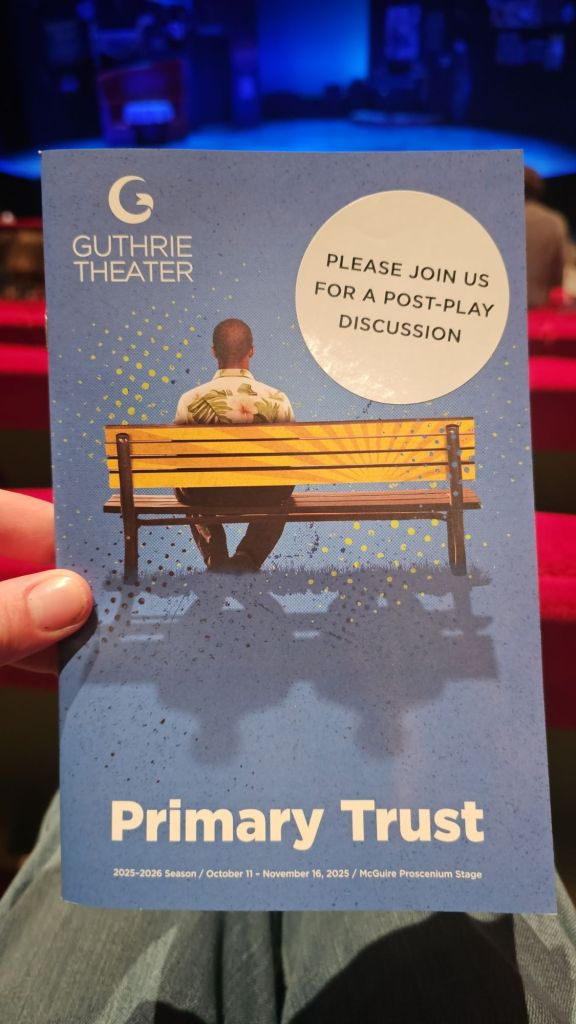
  • Although set in the 1990s, Primary Trust speaks directly to the “loneliness epidemic” of the modern era that so many have written and spoken about. Eboni Booth’s Pulitzer Prize-winning comedy-drama captures not only the pain of loneliness, but also how escaping it can create difficulties of its own.

    Kenneth (Bryce Michael Wood) is a man living in a suburb of Rochester, New York, and he’s been alone for so long he doesn’t recognize his own loneliness. His life consists of working at the same bookstore job he’s had since he was 18 and then spending his evenings drinking Mai Tais with his friend Bert (the always wonderful Will Sturdivant). Their relationship seems nice enough, but once its true nature comes to light, it becomes increasingly clear that Kenneth’s connection to Bert isn’t as healthy it seems. When he’s told his place of work is closing, Kenneth is forced to rethink his life and find another job. On the advice of friendly restaurant server Corria (Nubia Monks) he applies for a bank job, and while he takes to the work naturally, being surrounded by new people causes Kenneth to realize just how lonely he really is.

    Both star Bryce Michael Wood and director Marshall Jones III make their Guthrie debuts here, and they do terrific work managing the shifts in tone necessary to balance both the comedy and the sadness expressed in Eboni Booth’s script. It’s rather remarkable how well Wood is able to carry the show on his shoulders – his Kenneth is a true original. He’s socially awkward at the best of times, but not stereotypically so. It’s hard for him to make connections, but he’s not rude or standoff-ish towards others. It’s clear early on that Kenneth is in something of a state of arrested development, having never quite gotten over losing his mother at a young age and having to be raised in an orphanage. The things he has relied on at the play’s start- his job, drinks with Bert, the restaurant – are mostly crutches, and once he begins to realize that, the possible consequences begin to scare him even more. Other consequences aren’t touched on, through- the play doesn’t really dwell on the deeper implications of Kenneth’s daily drinking of Mai Tais, though. There’s no indication he’s an alcoholic, even though by his own estimation he’s been having his daily drinks for 15 years.

    The supporting cast is filled with local talent; not just Sturdivant, but also Nubia Brooks (last seen by me in last season’s The Nacirema Society) and Pearce Bunting (previously on this very stage in the Guthrie’s The Mousetrap). Brooks and Bunting both play multiple roles, and do so wonderfully. Brooks has a delightful scene where she plays both Corria and a male waiter unsuccessfully trying to flirt with her at the same time. Bunting makes his biggest impact as Kenneth’s boss at the bank, He gets a big laugh early on when he muses to Kenneth about having a brother who suffered brain damage before saying “You remind me of him!”, but that line also gets a tender call back later in the play when he shows that his relationship with his brother alllws him to understand Kenneth’s vulnerability, and wants to help him work through it.

    A Pulitzer Prize-winning play about a nice but very lonely man who drinks too much and needs to grow up makes me think a little bit of Harvey, but unlike in that classic play  there’s no real antagonist here, and I found that refreshing. Pretty much all of the characters are basically nice, and almost everyone who Kenneth encounters wants what’s best for him. The question is whether or not Kenneth is able to come to terms with his own issues and learn to trust other people. It’s a play that is smaller in scope than most put on at the Guthrie, but it still carries an impact. It makes you re-examine your own life experiences, and in between the laughs it can be almost painfully poignant.

    PRIMARY TRUST runs at the Guthrie Theatre’s McGuire Proscenium Stage until November 16

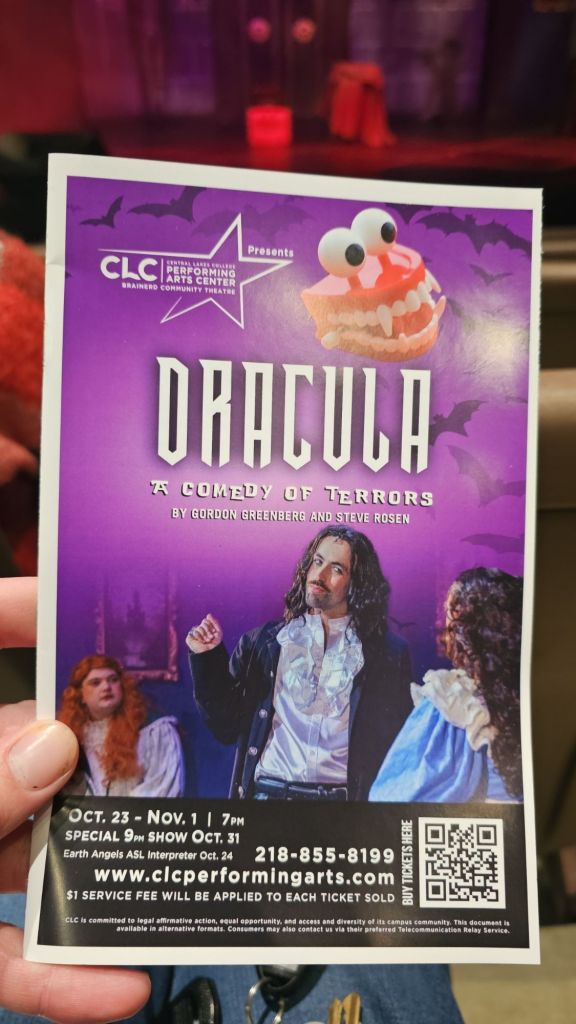
  • Just in time for the start of Spooky Season, Brainerd Community Theatre has brought everybody’s favorite undead Romanian nobleman back to the stage. But this production is anything but a traditional take on the Count. This adaptation by Gordon Greemberg & Steve Rosen, directed by BCT stalwart Amy Borash, is a fast-paced farce that lampoons every element of Bram Stoker’s tale and then some.

    For a show as broad and silly as this, there’s a temptation to primarily judge it on the simplest of terms – did I laugh? Absolutely I laughed – there were hardly five minutes that went by in this 90-minute show without a chuckle, chortle, or belly laugh. But there’s more to appreciate here than just a series of jokes – there’s a ton of skill on display in their execution. Director Borash and her cast execute a smorgasbord of classic comedy tropes with a clever modern sensibility. What may be most impressive is how the cast, while being hilarious all the way through, never appear to be stretching for a joke. There’s no winking at the audience during this show, even if the material seems like it would invite it. All of the characters take the story deadly seriously, so the actors do as well, which inevitably makes the comedy all the more funny.

    The cast consists of five actors, four of whom play multiple parts. The only actor with a sole credit is Matt Hill as the title character. Hill plays the Count like an omnisexual 19th-century rock star.  He’s just out for a good time. Of course, his idea of a good time tends to involve more exsanguination than most.

    The Count also gets his kicks through manipulation and seduction, and he doesn’t discriminate – Lucy might be his primary target, but Dracula isn’t above cuddling with and smooching, either. Harker is played by Jacob Becker in an impressive balancing act. This version of Harker is a neurotic hypochondriac terrified of anything that might involve risk. That sort of characterization could easily become too much in the hands of the wrong actor, but Jacob Becker manages to keep him likeable, and when he finally gets the chance to cut loose near the show’s end, he clearly relishes it. As Lucy, Nancy Topete brings an appealing willfulness, making their character as strong and confident as Harker is wimpy and neurotic. Special recognition should go to Nicole Rothluetner and Noah Barnhart, both of whom spend most of the show in drag, but are savvy enough performers to not make that the main butt of the joke. The genderbending is just one of many avenues of comedy in this show, and the two of them play their respective roles with dignity – or at least the amount of dignity that can be afforded to Rothluetner playing a complete chauvinist who can’t possibly imagine the idea of a woman doctor or Barnhart as the affection-starved sister of Lucy who is desperate for male attention, no matter who gives it. The whole ensemble moves so smoothly between their roles (or less than smoothly, when a joke can be made out of it, as happens a few times to delightful effect) that it sometimes feels like a magic trick.

    The set design fits the fast pace of the show, with pieces rotating in the background to signify changes of location and only a few key props brought on and off as necessary. The costumes by Rachael Kline are predictably excellent, and the sound and lighting design bring the audience into the setting wonderfully.

    DRACULA: A COMEDY OF TERRORS runs until November 1st at the Chalberg Auditorium at Central Lakes College in Brainerd.

  • Hello, everybody. I figured I could use a spot to do more long-form writing on the various topics that spark my interest. And as is so often the case for me, I find myself joining a trend about a decade after it stopped being trendy.

    So welcome to my blog!

    Mostly, this will serve be a platform for my reviews and commentary on theatre. I see a lot of local and regional theatre in Minnesota, and especially in the rural part of the state where I live, there’s a dearth of writing about the arts in general and theatre in particular. I feel theatre of all stripes deserves criticism – it’s what helps it grow, both commercially and artistically.

    It won’t just be theatre commentary – I’ll probably spend time musing on my other interests along the way – cooking, film, what have you – but these days I find myself thinking and writing about theatre more than most other topics.

    At the same time I can’t pretend I’m not personally invested in the success of many of the groups I’ll be writing about, having worked with and for community theatres from Wadena and Staples to as far away as Brainerd and Little Falls. Many of the people in these productions are people I consider friends, and I know that will impact my objectivity.

    But criticism is not about objectivity – it never has been. It’s about sharing how a piece of art impacted you, and what your experience may mean for others. When people read reviews, they should be able to judge whether the thing being reviewed is worthwhile to them, whether the reviewer liked it, disliked it, or was ambivalent about it. If the artists are the seeds and the works are the plans, and audiences are the fertilizer, critics and commentators could be seen as the symbiotic insects who live on them. We need the ecosystem to keep going, and it’s in our interest to help it grow, even if our presence can be annoying.

    So welcome, friends and neighbors.  Let’s come together and help the arts grow.